
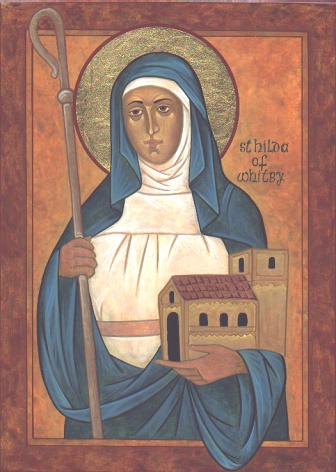
 Saint Hilda of Whitby
In March 2026, we reflected on the life of that great woman, Brigid of Kildare. That reflection provided inspiration for a similar reflection on another great woman, Hilda of Whitby. Brigid and Hilda, although separated by a hundred years, had much in common, not least that they were both Abbesses of very large communities of men and women.
With the withdrawal of the Romans in 410, and invasion by the Anglo-Saxons; Britain fragmented into small warring kingdoms. Invasion, war and violence was the order of the day with each king vying for power. In 614, Hilda was born into the Royal Family of Northumbria, which included Yorkshire. While she was still an infant, her father was violently murdered, and her mother fled with Hilda and her sister. Edwin, King of Northumbria, offered them refuge in his royal court where, growing up in a pagan household, Hilda was taught to worship pagan gods.
With the withdrawal of the Romans from Britain, the Christian faith also weakened. Thus, it was, that in 597, Pope Gregory the Great sent 20 (some say 40) Monks, led by Augustine, to re-establish Christianity among the Anglo- Saxons. The King of Kent made them welcome. He and a great number of his subjects were baptised. Edwin resisted Christianity, but after several miraculous experiences, he submitted. He and his household, including Hilda, were baptised on the 12th of April 627.
Edwin married the daughter of the King of Kent and, as part of the marriage agreement, she brought the Roman Priest, Paulinus, with her as her Chaplain. Paulinus was a strong Roman influence. In the North of England, there was an equally strong Celtic Church. The early Celtic monks had come from Ireland via Iona to Lindisfarne (Holy Island) in the early 7th Century. Their mission was the same as that of Gregory the Great – to renew the Christian faith in Britain. The Roman approach was to build huge churches where liturgies could be celebrated with a lot of pomp and ceremony. Their purpose was to attract people to the faith.
The Celtic approach was to build communities where all were equal. The monks went about in the ordinary woolen garb of the people and preached to the people where they found them. At the center of this community there was a rough building, probably stone and thatch, where all gathered to pray.
Oswy, the then King of Northumbria, had lived for a time on Iona. Aidan, the Bishop of Northumbria, had also come from Iona to Lindisfarne. Aidan became one of the strongest influences in Hilda’s life. Hilda, now in her early thirties, was seeking to live her faith more fully and was planning to join her sister in a French convent. When Aiden heard this, he asked her to help him build a Christian community at a place near Hartlepool on the Yorkshire coast. Despite her inexperience of monastic life, Hilda agreed. She went to Lindisfarne for a time, where she was helped to draw up a Rule of Life; and the Lindisfarne monks continued to provide training by visiting Hartlepool. In Hartlepool, Hilda developed a routine of prayer and work. Hilda continued at Hartlepool with a lot of support from Lindisfarne. But war broke out again and Aidan, witnessing the death of some of his closest friends, died of a broken heart. Finan replaced Aidan as Bishop of Northumbria, which had now emerged stronger than before.
The King and the new Bishop asked Hilda to take over the running of Whitby which was a much greater than Hartlepool. Hilda was an educated woman who had access to the best teachers and books both in the Court and East Anglia. She was to turn Whitby into the most significant monastery for men and women in England. Whitby was described as having 40 to 50 stone cells. The walls were half timbered with stone foundations, and the settlement was divided into living and working areas. Men and women cells were separated but there was a shared chapel where they met for common prayer. As well as being a center of learning, it also had a scriptorium. There is a Northumbria Bible preserved in Florence which contains 2000 pages and weighs 90 pounds. Beyond the monks living quarters were fields and accommodation for those who worked the land.
In 664, Whitby became the setting for one of the most defining moments in the English Church – The Synod of Whitby.
The differences between the Roman and Celtic approaches to living the Christian faith were in danger of causing a split in the Church. It must be noted, there was no disagreement about matters of Doctrine, but rather of practical matters such as the date of Easter. In some places, Easter was observed twice. An important underlying issue was whether England should submit to Roman governance. After much debate, the vote was in favour of Rome. It is said that some Celtic monks walked away. Hilda, who strongly supported the Celtic approach, with great humility accepted and supported the outcome.
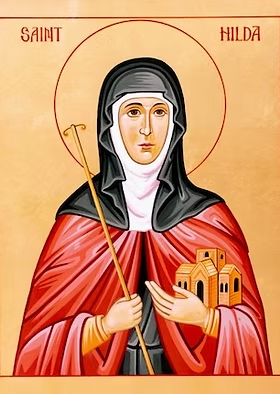 Hilda remained in Whitby until her death in 680. Even though she was very ill for the last seven years of her life, she continued to instruct her flock to live in goodness and peace.
As with Brigid, there were many legends told of Hilda. Just to mention two of them here! It is said that she cleansed Whitby of snakes by casting them in the sea. They are now represented by the ammonite fossils found around Whitby. Further proof – the Whitby coat of arms has three snakes on it!
There is also the story of Caedmon a young, uneducated, herdsman. Caedmon, it is said, lacked self-confidence. At celebrations, when it was his turn to play music, he stole away from the gathering. On one such night Caedmon had a dream. In the dream he paraphrased a story from scripture, which he loved, and put it to music. When he woke up, not only could he remember the song, but he was able to add further verses. Surprised at his ability to do this, he told the Reeve who immediately informed Hilda. She took him and trained him as a monk where he could continue creating his poetry. These songs travelled far into the memories of those who could not read. It is believed that this music/poetry still existed until it was destroyed by the Vikings.
Hilda and Brigid – one wonders how many other great women have been forgotten.
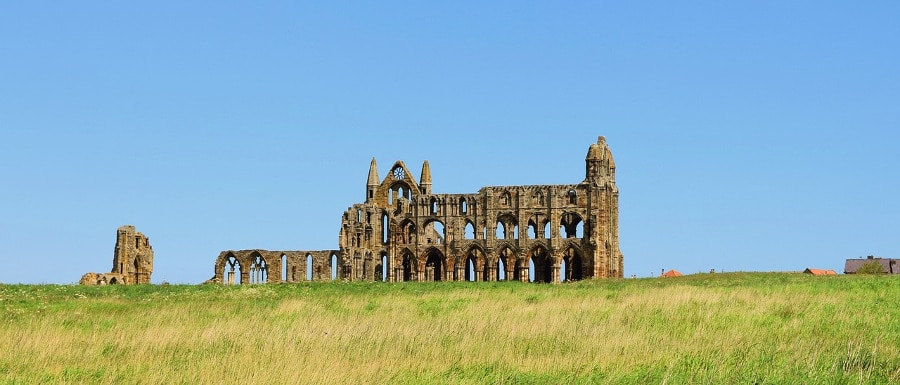
These two pictures are the ruins of an 11th century Benedictine Monastery built on the site of Hilda’s Abbey. Archaeologist have found evidence of Hilda’s Abbey.
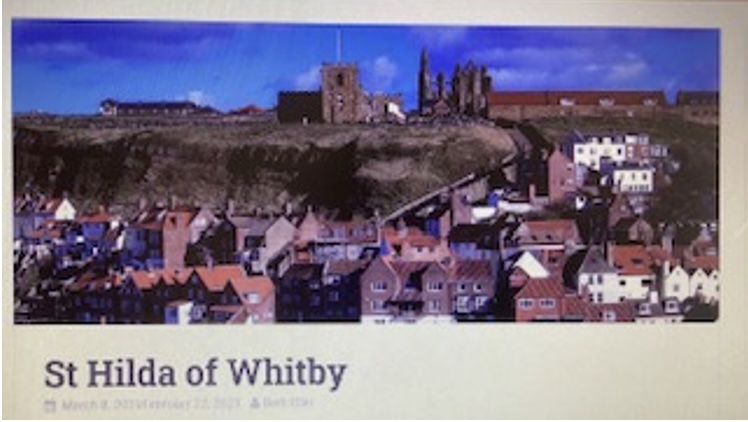
RECENT ARTCILE
There was an article in the Guardian on the 29th April 2026. Which we thought would support the above reflection.
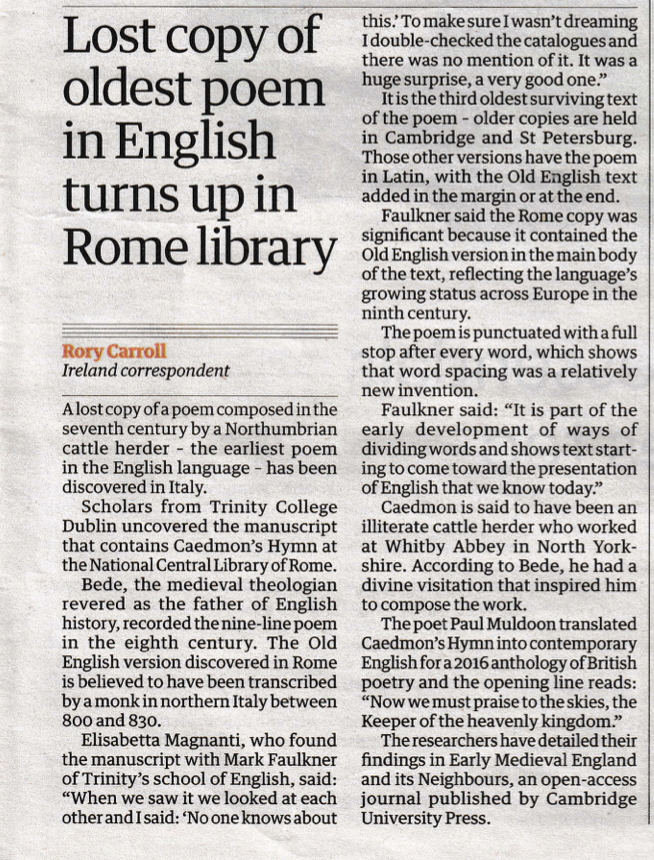
Guardian 29th April 2026
wish you all the best
Thank you for that very interesting account of Hilda.
Though I studied in Yorkshire & one of the TASC student blocks was called Whitby
I knew nothing about that remarkable woman .,
Thank you for this reflection on St Hilda of Whitby. I have fond memories of visiting Whitby and appreciate being reminded of this strong woman and the comparison with Brigid. I loved the piece where it mentioned growing communities where all are equal and lets hope the Synodal journey will bring the Church along this path and towards unity. Our own Elizabeth Prout too carried this strength and let’s pray in gratitude for all the strong women we have known and all who inspire us.
Thank you for that historical account of Hilda and the struggles of her time. The reference to the difference between the Celtic and Roman approaches to Christian practice is interesting
Thank you so much sisters for this lovely account of St Hilda of Whitby! It is a treasure and a lovely link to Brigid, another strong Celtic women. I love the last line where you wonder how many other great women have been forgotten! We, of course have lived with many great Sisters in our own lifetimes! Deo Gratias. I am now going to look for Caedmon’s Hymn……
I remember visiting Whitby in 2015 with sisters Anne Hammersly and Moya OCleary and walking all around the ruins. The steps up the hill from the town are still unforgettable for the exercise they subjected me to. This added history wasn’t part of the information available that day although Anne and Moya filled in the missing bits. I still have the photos.
Good to learn about great women of many years ago. Rich ancestry! Thanks for this! Blessings one and all
Thank you. I found this reflection on Hilda of Whitby very interesting and recall visiting Whitby a long while ago. I love the piece about building communities where all were equal. Hopefully the synodal approach will take us there in our times. Thank God for great women, our own Elizabeth Prout among them.
Thanks for a wonderful article on Hilda . I got a great appreciation of how strong Celtic spirituality was in the history of Northumberland, when I lived in Ministeracres. This article has brought back many happy memories of the Northern Saints